
Views: 0 Author: Site Editor Publish Time: 2026-07-10 Origin: Site


A dock leveler may look like a simple steel platform, but it plays a very important role in warehouse loading operations. It connects the warehouse floor with the truck bed, allowing forklifts and pallet trucks to move goods in and out smoothly. If the dock leveler is not suitable for the site, loading may become slow, unsafe, and difficult to manage.
In real warehouse operations, trucks do not always stop at the same height. Different truck models, different cargo weights, suspension changes, and road conditions can all affect the truck bed height. A suitable dock leveler helps compensate for these differences and creates a safer transition between the dock and the vehicle.

Choosing the wrong dock leveler can lead to more than just inconvenience. If the load capacity is too low, the platform may wear out quickly or become unsafe. If the size is not correct, forklifts may face steep angles or unstable movement. If the operation method does not match the loading frequency, workers may spend too much time and energy operating the equipment.
This is why buyers should not choose a dock leveler only by price. A good dock leveler should match the actual working conditions of the warehouse. It should support safe loading, reduce downtime, improve efficiency, and provide reliable performance over many years.
The best dock leveler is not always the most expensive model. It is the model that fits your warehouse, your trucks, your cargo, and your daily operation. Before choosing, you need to understand how your loading dock works and what problems the equipment needs to solve.
If your warehouse only handles a few trucks per day, you may not need a highly automated dock leveler. In this case, a mechanical dock leveler or an edge-of-dock leveler may be enough. These models are usually more economical and can meet basic loading needs.
For small warehouses, backup loading bays, or facilities with light-duty operation, a simple solution can still work well. The key is to make sure the equipment is used within its correct working range.
Mechanical dock levelers are suitable when power supply is limited or when manual operation is acceptable. Edge-of-dock levelers are suitable for retrofit projects or smaller loading areas where a full dock pit is not available.
If your warehouse loads and unloads trucks every day, especially with frequent forklift traffic, a hydraulic dock leveler is usually a better choice. It is easier to operate, more stable, and reduces manual labor.
For logistics centers, distribution warehouses, manufacturing plants, and busy storage facilities, efficiency matters a lot. A hydraulic system helps workers operate the dock leveler quickly and safely with button control.
Hydraulic dock levelers are practical for most high-frequency loading areas. If your warehouse handles many truck types or requires more accurate lip positioning, a telescopic dock leveler may be more suitable.
Load capacity is one of the most important factors when choosing a dock leveler. The dock leveler must support the forklift, the operator, and the cargo at the same time. Many buyers only consider the cargo weight, but this is not enough.
For example, if a forklift carries a heavy pallet, the total load on the dock leveler includes the forklift weight, the pallet weight, and the dynamic impact during movement. When the forklift drives across the platform repeatedly, the dock leveler experiences pressure, vibration, and impact.
It is better to leave a safety margin when selecting load capacity. If your actual working load is close to the rated capacity, the dock leveler may wear faster over time. A stronger capacity can provide better safety and longer service life.
Different warehouses handle different goods. A food warehouse may mainly handle palletized cartons. A manufacturing plant may handle machinery parts or heavy raw materials. A building material warehouse may need to move heavy steel, stone, or equipment.
The heavier the goods, the stronger the dock leveler structure should be. Platform thickness, support beams, lip structure, hydraulic system, and welding quality all affect long-term performance.
For heavy-duty loading, choose a dock leveler with reinforced steel structure and suitable rated capacity. Do not use a light-duty model for heavy forklifts or high-impact loading. This can reduce safety risks and maintenance problems later.
Truck information is very important when choosing a dock leveler. A warehouse may receive standard trucks, container trucks, refrigerated trucks, small delivery vehicles, or different carrier fleets. Each truck type may have a different bed height and rear structure.
If the truck bed is much higher or lower than the warehouse floor, the dock leveler angle may become too steep. This can make forklift movement unsafe and reduce loading efficiency.
Before choosing a dock leveler, confirm the truck bed height range, truck width, rear door type, loading method, and how the truck parks at the dock. If possible, provide site photos and truck photos to the supplier for better evaluation.
If your warehouse handles different truck types, you may need a dock leveler with better adaptability. A standard hinged-lip dock leveler can work for many common trucks, but it may not always provide the best positioning for containers or refrigerated vehicles.
A telescopic dock leveler has an extendable lip, which allows more accurate connection with the truck bed. This is useful when the contact area is limited or when precise positioning is required.
A telescopic dock leveler is suitable for warehouses that handle mixed truck fleets, containers, cold chain vehicles, or high-value goods. It provides better control and helps improve loading stability.
A hydraulic dock leveler is one of the most common choices for modern warehouses. It uses a hydraulic system to lift the platform and operate the lip. Workers can control it by pressing buttons, which makes operation easier and safer.
This type is suitable for warehouses with regular or frequent loading. It is widely used in logistics centers, distribution centers, food factories, cold storage warehouses, and manufacturing plants.
Hydraulic dock levelers are best for medium to high-frequency loading, heavier cargo, and facilities that want easier operation and stable performance.
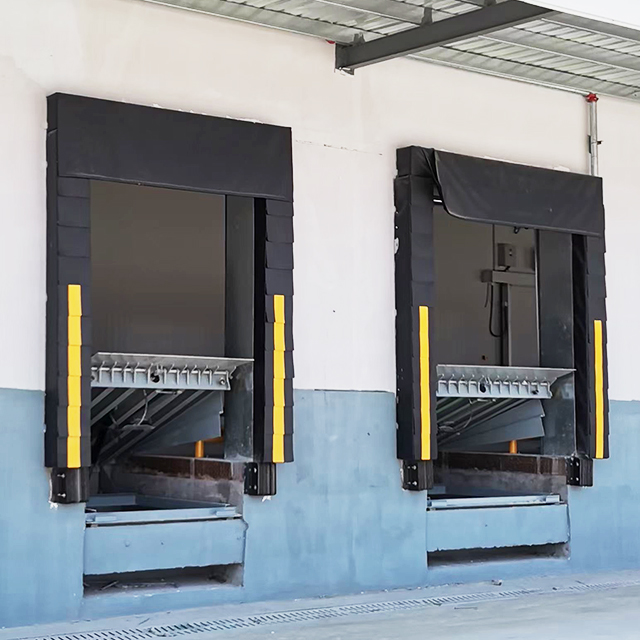

A mechanical dock leveler is usually operated manually. It does not require electrical power, which makes it useful for sites where power supply is limited or loading frequency is low.
It is more economical than a hydraulic model, but it requires more manual effort. If workers need to operate it many times per day, the operation may become tiring.
Mechanical dock levelers are best for small warehouses, low-frequency loading, backup loading bays, and budget-sensitive projects.


An airbag dock leveler uses an airbag lifting system to raise the platform. It does not rely on traditional hydraulic lifting cylinders. When the airbag inflates, the platform rises; when the airbag releases air, the platform lowers.
This type can provide smooth operation and a relatively simple lifting structure. It is suitable for many general warehouse applications.
Airbag dock levelers are suitable for general warehouses that want smooth operation and an alternative to hydraulic lifting systems.


A telescopic dock leveler has an extendable lip instead of a standard hinged lip. This allows the lip to reach further into the truck bed and improves positioning accuracy.
It is especially useful for containers, refrigerated trucks, and facilities where loading precision matters.
Telescopic dock levelers are best for mixed truck fleets, cold chain loading, container loading, and warehouses with higher safety or sealing requirements.


A vertical dock leveler is stored upright when not in use. This allows the dock door to close tightly to the floor, improving sealing performance and hygiene.
It is often used in cold storage, food processing, pharmaceutical warehouses, and temperature-controlled facilities.
Vertical dock levelers are best for facilities that require better temperature control, cleaner dock areas, and stronger sealing performance.


An edge-of-dock leveler is installed at the edge of the loading dock instead of inside a pit. It is compact and easier to install, especially for existing warehouses that do not have a standard dock pit.
However, it has a smaller operating range and is not ideal for heavy-duty or high-frequency loading.
Edge-of-dock levelers are best for light-duty loading, low-frequency use, small warehouses, and retrofit projects.


A baffle dock leveler is usually selected for special loading conditions or customized dock layouts. It may include additional structural features to support specific safety, guidance, or site requirements.
This type is more project-based and should be recommended according to the actual loading dock condition.
Baffle dock levelers are best for special site conditions, customized loading requirements, or projects where standard dock levelers cannot fully match the operation.
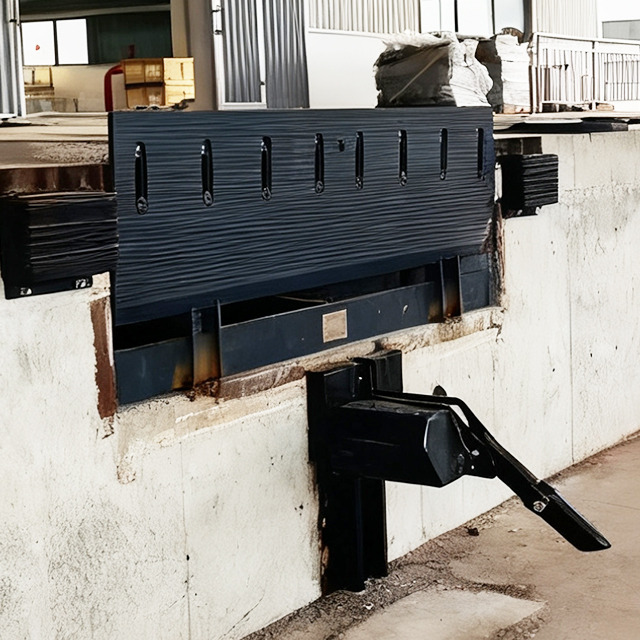

If you are choosing a pit-mounted dock leveler, pit size is very important. The length, width, depth, and dock height must match the equipment. If the pit dimensions are incorrect, installation may become difficult or the dock leveler may not work properly.
Before production, it is better to confirm all dimensions with drawings or site measurements. This helps avoid costly installation changes later.
You should confirm the pit length, pit width, pit depth, dock height, opening width, wall condition, and truck approach area. These details help the supplier recommend the correct model and size.
Hydraulic dock levelers and some other models require power supply. Before ordering, confirm the local voltage, phase, frequency, and control requirements.
If the site does not have convenient power access, you may need to consider a mechanical dock leveler or prepare electrical work before installation.
Incorrect voltage or unclear electrical requirements can delay installation. Always confirm power conditions before finalizing the order.
The loading dock wall, floor, and pit structure must be strong enough to support the dock leveler. For heavy-duty applications, the civil construction quality is especially important.
If the site is an old warehouse, additional inspection may be needed before installing new dock equipment.
For retrofit projects, check whether the dock edge, pit area, and surrounding floor are still in good condition. If the structure is weak or damaged, repair work may be needed before installation.
For general warehouses, basic weather protection may be enough. A standard hydraulic dock leveler, mechanical dock shelter, and industrial sectional door can usually meet daily loading needs.
The main goal is to protect the dock area from rain, wind, and dust while keeping loading safe and efficient.
For general warehouse loading, a hydraulic dock leveler can be used together with a mechanical dock shelter and sectional door. This combination is practical, reliable, and suitable for many common projects.
Cold storage warehouses need better sealing and temperature control. If the loading dock is not sealed properly, cold air can escape quickly, increasing energy consumption and affecting product quality.
For this type of facility, the dock leveler should work together with insulated doors and high-performance dock shelters.
For cold storage, a telescopic or vertical dock leveler can be used with an inflatable dock shelter and insulated sectional door. This helps reduce air leakage and improve energy efficiency.
Food and beverage warehouses often need cleaner loading environments. Dust, insects, moisture, and outside air should be controlled as much as possible.
In this case, sealing performance and easy cleaning are important factors when selecting dock equipment.
A well-sealed dock system with a suitable dock leveler, inflatable dock shelter, and fast-operating door can help maintain a cleaner and more efficient loading area.
A dock leveler should not be considered alone. Loading docks are busy areas where trucks, forklifts, workers, and goods move at the same time. Safety accessories can help reduce accidents and protect both people and equipment.
Dock bumpers, vehicle restraints, warning lights, safety barriers, and anti-slip surfaces all play important roles in a safe loading dock system.
A vehicle restraint keeps the truck in position during loading. This helps reduce the risk of truck movement or separation from the dock while forklifts are moving in and out.
Dock bumpers are installed on the dock wall to absorb impact when trucks reverse into position. They protect the building, the truck, and the dock equipment from damage.
Although they are small accessories, they are very important for long-term dock protection.
Safety accessories may not look as important as the dock leveler itself, but they help create a more complete and reliable loading dock system.
When buying a dock leveler, it is easy to focus only on the initial price. But the real cost includes installation, maintenance, downtime, energy loss, safety risk, and service life.
A cheaper dock leveler may cost more in the long run if it breaks often, does not match the site, or slows down loading work.
A better dock leveler can reduce maintenance problems, improve loading speed, and support safer daily operation. For busy warehouses, long-term reliability is often more valuable than a small saving at the beginning.
Before choosing a supplier, check the steel structure, platform thickness, lip design, welding quality, surface treatment, hydraulic system, control system, and safety configuration.
These details affect how the dock leveler performs after years of daily use.
A professional supplier should be able to provide product drawings, technical parameters, load capacity details, installation requirements, and configuration options. This helps you make a more confident buying decision.
The cheapest model is not always the most suitable one. If the dock leveler does not match your warehouse operation, it may cause more problems later.
Always choose according to loading frequency, truck type, cargo weight, site condition, and safety requirements.
Truck bed height directly affects dock leveler performance. If the height difference is too large, the platform angle may become unsafe for forklift operation.
Before ordering, collect truck height information or provide truck details to the supplier. This helps select the correct dock leveler size and working range.
Some warehouses choose equipment only based on current needs. But if the business grows, loading frequency and cargo weight may increase.
If your warehouse may expand in the future, it is better to choose a dock leveler with enough capacity and durability from the beginning.
Before requesting a quotation, prepare the basic project information. This will help the supplier recommend a more accurate dock leveler solution and avoid repeated communication.
You should provide warehouse opening size, dock height, pit dimensions, truck types, truck bed height range, cargo weight, forklift weight, loading frequency, power supply, and site photos if available.
A dock leveler is not just a standard product. It needs to match the real loading dock. Clear project information helps the supplier choose the right type, size, capacity, and configuration.
Before confirming the order, ask whether the model is suitable for your truck height range, whether the capacity has enough safety margin, what installation requirements are needed, and what maintenance should be expected.
You can also ask for drawings, product photos, project cases, and operation videos to better understand the product.
A professional supplier should not only give a price. They should help you check the working conditions and recommend a suitable solution based on safety, efficiency, and long-term use.
Choosing the right dock leveler for your warehouse requires more than comparing prices. You need to understand your loading frequency, truck types, cargo weight, dock height, pit dimensions, power supply, sealing requirements, and safety needs.
For general warehouse loading, a hydraulic dock leveler is often a practical and reliable choice. For low-frequency use, a mechanical dock leveler or edge-of-dock leveler may be enough. For mixed truck fleets or more accurate positioning, a telescopic dock leveler can be a better option. For cold storage, food facilities, or temperature-controlled warehouses, vertical dock levelers and well-sealed dock systems may provide better performance.
The right dock leveler can make loading safer, faster, and more efficient. More importantly, it can reduce long-term operation problems and help your warehouse handle daily loading work with greater confidence.


