
Views: 0 Author: Site Editor Publish Time: 2026-07-07 Origin: Site


A warehouse loading dock is not simply a place where trucks stop and goods move in or out. It is one of the most important working areas in the entire facility. Every day, forklifts, pallet trucks, workers, trucks, and cargo pass through this area repeatedly. If the dock area is not properly designed, even a small problem can affect the whole operation.
For example, when the height difference between the truck bed and the warehouse floor is not handled correctly, loading becomes slower and less stable. When the dock opening is not sealed well, dust, rain, hot air, cold air, or insects may enter the building. When trucks are not secured during loading, there may be safety risks for both workers and goods. This is why choosing the right loading dock equipment is not only about convenience, but also about safety, efficiency, energy saving, and long-term operating cost.

The right loading dock equipment can improve the full loading and unloading process. A suitable dock leveler creates a smooth bridge between the truck and the warehouse floor. A proper dock shelter or dock seal helps reduce air exchange and protect goods from weather conditions. An industrial sectional door or high speed door controls access and supports better indoor temperature management. Vehicle restraints help keep trucks in position and reduce movement during loading.
When these products work together, the loading dock becomes a complete system instead of a group of separate products. This system can reduce waiting time, protect workers, improve loading accuracy, and make the warehouse easier to manage.
Dock levelers are one of the most common pieces of loading dock equipment. Their main function is to compensate for the height difference between the warehouse floor and the truck bed. Without a dock leveler, forklifts may have difficulty entering the truck safely, especially when different trucks have different loading heights.
Hydraulic dock levelers are suitable for warehouses with frequent loading and unloading operations. They are easy to operate and can be controlled by buttons, reducing manual labor. For busy logistics centers, distribution warehouses, cold storage facilities, and manufacturing plants, hydraulic dock levelers are often a practical choice because they improve efficiency and provide stable performance.

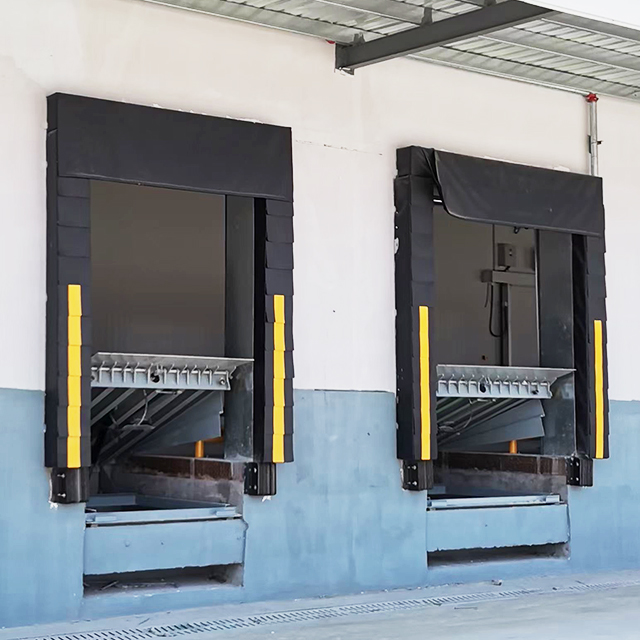
Mechanical dock levelers are usually operated manually and do not require a power supply. They can be a good option for facilities with lower loading frequency or where electrical installation is limited. Although they require more manual operation than hydraulic models, they are still widely used because of their simple structure and lower maintenance requirements.


Telescopic dock levelers are designed with an extendable lip. Compared with standard hinged-lip dock levelers, they allow more precise positioning inside the truck. This is especially useful when loading containers, refrigerated trucks, or vehicles where the available contact area is limited. For warehouses that handle different truck types, telescopic dock levelers can provide better flexibility.


Dock shelters and dock seals help close the gap between the truck and the warehouse opening. Their main purpose is to improve sealing performance, protect goods from external weather, and support a cleaner indoor environment.

Mechanical dock shelters are commonly used in general warehouses and logistics centers. They usually include side curtains and a top curtain to cover the truck opening area. They are suitable for different truck sizes and can help reduce rain, wind, and dust entering the warehouse.
Inflatable dock shelters provide better sealing performance because the airbags inflate around the truck body after the vehicle is in position. They are especially useful for cold storage, food processing, pharmaceutical warehouses, and temperature-controlled facilities. If a warehouse needs to reduce energy loss and maintain a stable indoor environment, inflatable dock shelters are often a better choice.
Dock seals usually use foam pads to press against the truck body. They are simple and effective for facilities with relatively fixed truck sizes. If the warehouse handles trucks with similar dimensions every day, dock seals can offer good sealing performance at a reasonable cost.
Doors are another important part of the loading dock system. They help control access, protect the warehouse, and maintain the indoor environment. The correct door type depends on the working frequency, temperature requirements, building structure, and traffic flow.
Industrial sectional doors are commonly used at warehouse loading dock openings. They have insulated panels and can provide good sealing, safety, and durability. For facilities that need reliable closing performance and better thermal insulation, sectional doors are a common solution.

High speed doors are suitable for areas with frequent traffic. They open and close quickly, reducing waiting time and helping separate different working zones. In warehouses where forklifts move in and out frequently, high speed doors can improve workflow and reduce air exchange between areas.

High speed spiral doors are suitable for industrial environments that require both fast operation and stronger door panels. They are often used in exterior openings, logistics centers, and industrial buildings where wind resistance, security, and speed are all important.

Vehicle restraints help secure trucks at the loading dock and reduce the risk of truck movement during loading. This is important because unexpected truck movement can create serious safety hazards.

During loading and unloading, forklifts repeatedly move between the warehouse floor and the truck. If the truck moves away from the dock, even slightly, the gap can become dangerous. A vehicle restraint helps hold the truck in place and gives workers a safer operating environment.
Besides vehicle restraints, many warehouses also use dock bumpers, wheel guides, traffic lights, safety barriers, and warning signs. These accessories may seem small, but they help protect the building, guide truck drivers, and reduce the risk of accidents around the dock area.
Before choosing any equipment, the first step is to understand how your warehouse operates. A small storage warehouse and a busy logistics distribution center do not need the same loading dock solution. The more frequent the loading activity, the more important equipment stability, automation, and safety become.
If your warehouse handles only a few trucks per day, a simple mechanical dock leveler and standard dock shelter may be enough. If your facility handles continuous truck loading, hydraulic dock levelers, inflatable dock shelters, vehicle restraints, and high-performance industrial doors may be more suitable.
You should consider how many trucks arrive each day, what types of vehicles are used, how heavy the goods are, and whether forklifts need to enter the truck directly. You should also check whether the facility requires temperature control, dust control, or special hygiene standards.
These questions help you avoid choosing equipment only based on price. A low-cost solution may look attractive at the beginning, but if it does not match the working conditions, it may slow down operations and create higher costs later.
Different trucks may have different bed heights, rear door structures, and loading requirements. If your warehouse receives standard trucks only, a regular dock leveler may work well. But if you handle containers, refrigerated trucks, or vehicles with different heights, you may need a more flexible solution.
For warehouses that handle many truck types, telescopic dock levelers are often useful because the extendable lip can be positioned more accurately. Adjustable dock shelters or inflatable dock shelters can also help fit different vehicle sizes more effectively.
If your warehouse mainly works with the same type of truck, a simpler solution may be enough. A standard hydraulic dock leveler, dock seal, and sectional door can provide stable performance without unnecessary complexity.
Load capacity is one of the most important factors when choosing dock equipment. The selected dock leveler must be able to support not only the weight of the forklift but also the weight of the goods being carried.
If your daily working load is close to the rated capacity of the equipment, it is better to choose a stronger model. Loading dock equipment is used repeatedly, and long-term impact, vibration, and heavy traffic can affect its service life. Choosing a higher capacity can help improve safety and durability.
For warehouses handling steel, machinery, building materials, or other heavy goods, a heavy-duty dock leveler with a reinforced steel structure is usually recommended. The surface plate thickness, support structure, lip design, and hydraulic system should all match the real working conditions.
Some warehouses only need basic weather protection, while others need strict temperature control. The equipment should be selected according to the indoor environment.
Cold storage and food facilities require better sealing and temperature control. Inflatable dock shelters, insulated sectional doors, and cold storage high speed doors can help reduce cold air loss and maintain a cleaner working environment. In these facilities, energy saving is often one of the key reasons for choosing higher-performance equipment.
For ordinary logistics or storage warehouses, mechanical dock shelters and industrial sectional doors are often enough. They can protect the loading area from rain, wind, and dust while keeping the investment reasonable.
Even good equipment may not perform well if the site conditions are not suitable. Before placing an order, the warehouse opening size, dock height, pit dimensions, wall structure, available power supply, and truck approach area should all be checked carefully.
For dock levelers, the pit size and dock height are critical. For doors, the opening size, side room, headroom, and installation surface should be confirmed. For dock shelters, the wall condition and truck size range should be reviewed. These details help the supplier recommend the correct model and avoid installation problems.
Many loading dock projects require customized sizes. Warehouses may have different building structures, truck types, and operating habits. A professional supplier should be able to provide suitable product dimensions, configuration options, and installation suggestions based on the actual project.
Logistics centers usually have high traffic, tight delivery schedules, and frequent truck movement. For this type of facility, efficiency is very important. Hydraulic dock levelers, high speed doors, vehicle restraints, and durable dock shelters are commonly recommended.
A practical solution may include hydraulic dock levelers for stable loading, mechanical or inflatable dock shelters for sealing, high speed doors for fast traffic flow, and vehicle restraints for truck safety. This combination can support frequent operations and reduce waiting time.
Cold storage warehouses need to control temperature and reduce energy loss. The loading dock area is one of the main places where cold air can escape. If the dock area is not properly sealed, the refrigeration system will need to work harder.
For cold storage, inflatable dock shelters, insulated sectional doors, cold storage high speed doors, and well-sealed dock levelers can provide better performance. The goal is not only to load goods safely, but also to reduce temperature fluctuation and improve energy efficiency.
Manufacturing plants may handle raw materials, finished products, machinery parts, and heavy goods. The loading dock equipment must be strong enough to handle regular industrial use.
Hydraulic dock levelers with suitable load capacity, heavy-duty sectional doors, dock bumpers, and clear safety guidance are usually important. If the plant has frequent forklift traffic, high speed doors can also improve internal movement between production and loading areas.
Food and beverage facilities often require cleanliness, temperature stability, and efficient goods movement. The loading area should reduce dust, insects, and external air entering the building.
Inflatable dock shelters, insulated doors, high speed doors, and easy-to-clean dock equipment are suitable choices. Good sealing performance can help protect product quality and support a cleaner working environment.
Price is always important, but it should not be the only factor. Loading dock equipment is a long-term investment. A cheaper product may cost more later if it causes downtime, safety issues, frequent maintenance, or poor sealing performance.
When comparing different options, consider maintenance cost, service life, energy loss, working efficiency, and safety performance. A better-matched solution can often save more money over time.
Some buyers choose equipment based only on warehouse opening size, but truck conditions are equally important. Truck bed height, truck width, rear door design, and parking position all affect equipment selection.
Before confirming the solution, it is better to collect truck information or provide site photos and drawings. This helps the supplier recommend a more accurate product configuration.
A loading dock is a busy working area, and safety should never be ignored. Missing safety accessories may increase the risk of accidents.
A safer dock area may include vehicle restraints, warning lights, dock bumpers, anti-slip surfaces, side safety plates, and clear operation instructions. These details help protect workers, equipment, trucks, and goods.
A good supplier should not only provide one single product. Since loading dock equipment usually works as a system, it is better to choose a supplier that can provide dock levelers, dock shelters, industrial doors, safety accessories, and customized solutions together.
When products are selected from one complete system, the sizes, functions, and installation details are easier to coordinate. This reduces communication problems and helps the final project work more smoothly.
Loading dock equipment needs correct selection, production, installation, and after-sales support. A supplier with real project experience can help identify potential problems before production begins.
Before confirming the order, it is helpful to request product drawings, technical parameters, material details, and installation suggestions. This makes the project clearer and reduces misunderstanding during production and installation.
Good loading dock equipment should be built for long-term use. Steel structure, welding quality, surface treatment, hydraulic system, door panels, sealing materials, and control systems all affect performance.
Reliable equipment can reduce downtime and maintenance pressure. For busy warehouses, even one day of dock failure may affect delivery schedules. That is why product quality and service support should be considered from the beginning.
Choosing the right warehouse loading dock equipment is not only about buying a dock leveler, a door, or a dock shelter. It is about building a complete loading dock system that matches your warehouse operation, truck types, cargo weight, safety requirements, and environmental conditions.
For general warehouses, a standard combination of hydraulic dock levelers, mechanical dock shelters, and industrial sectional doors may be enough. For cold storage, food facilities, and temperature-controlled warehouses, better sealing solutions such as inflatable dock shelters and insulated doors are more suitable. For high-traffic logistics centers, fast operation, safety control, and durable equipment become more important.
The best solution always starts from the real working conditions of your facility. By checking truck types, loading frequency, load capacity, temperature requirements, installation space, and safety needs, you can choose equipment that improves efficiency, protects workers, reduces energy loss, and supports long-term warehouse performance.


