
Views: 0 Author: Site Editor Publish Time: 2026-07-09 Origin: Site


When people talk about loading dock equipment, the dock leveler is usually one of the first products mentioned. It looks simple from the outside: a steel platform installed at the loading dock to connect the warehouse floor with the truck bed. But in real warehouse projects, choosing the right dock leveler is not that simple.
Different warehouses have different truck types, loading frequencies, cargo weights, temperature requirements, and installation conditions. A dock leveler that works well for a small warehouse may not be suitable for a busy logistics center. A standard model may be enough for general loading, but a cold storage facility or a container loading area may need a more specialized solution.
That is why understanding different types of dock levelers is important before making a purchase. The right model can make loading safer, faster, and more stable. The wrong model may cause operation problems, higher maintenance costs, or even safety risks.

A dock leveler is designed to bridge the height difference between the warehouse floor and the truck bed. During loading and unloading, trucks may sit at different heights because of vehicle type, suspension condition, cargo weight, or road surface. The dock leveler creates a smooth transition so forklifts, pallet trucks, and workers can move goods in and out of the truck more safely.
A dock leveler helps solve common loading dock problems such as height gaps, uneven transitions, unstable loading paths, slow manual handling, and forklift impact during entry and exit. It also helps reduce product damage and improve worker safety.
Different dock leveler types exist because loading conditions are not the same everywhere. Some warehouses need simple manual operation. Some need fast and frequent use. Some need better sealing performance. Some have limited installation space. Some handle heavy goods, while others mainly handle light pallets. Each type of dock leveler is designed for a different working situation.
A hydraulic dock leveler is one of the most widely used dock leveler types in modern warehouses. It uses a hydraulic power system to lift the platform and operate the lip. The operator usually only needs to press a button, and the dock leveler will rise, extend or open the lip, and then lower onto the truck bed.
This type is popular because it is easy to operate, stable, and suitable for frequent loading and unloading. Compared with manual models, hydraulic dock levelers reduce labor intensity and improve working efficiency.


The hydraulic system usually includes a power unit, hydraulic cylinders, control box, platform, and lip. When the operator presses the button, the hydraulic cylinder lifts the platform. Then the lip opens and rests on the truck bed. After loading is finished, the dock leveler returns to its stored position.
The biggest advantage is easy operation. Workers do not need to manually pull or lift the platform, which makes daily work safer and more convenient. Hydraulic models also provide smoother movement, better control, and more stable performance for busy loading docks.
Hydraulic dock levelers are suitable for logistics centers, distribution warehouses, manufacturing plants, cold storage warehouses, food factories, and facilities with medium to high loading frequency. If trucks come in and out every day and forklifts are used often, hydraulic models are usually a reliable choice.
You should consider a hydraulic dock leveler if your warehouse has frequent truck loading, heavier cargo, strict safety requirements, or operators who need easier control. It is also a good option when long-term efficiency is more important than only saving initial cost.
When choosing a hydraulic dock leveler, pay attention to load capacity, platform size, lip length, hydraulic system quality, steel thickness, and pit dimensions. Do not choose the capacity too close to your actual working load. A safety margin is always important for long-term use.
A mechanical dock leveler is a manually operated dock leveler. It usually uses a spring system or mechanical structure to help lift the platform. Unlike hydraulic models, it does not require electrical power for operation.
Mechanical dock levelers are simple, practical, and cost-effective. They are often used in warehouses where loading frequency is not very high or where the buyer wants a more economical solution.


The operator usually pulls a release chain or handle to activate the dock leveler. The platform rises with the help of the spring system. Then the lip flips out and rests on the truck bed. After loading, the operator returns the platform to the stored position.
The main advantages are simple structure, no power requirement, and lower initial cost. For facilities with limited electrical installation or lower daily loading volume, mechanical dock levelers can be a practical solution.
Mechanical models require more manual operation. If workers need to use the dock leveler many times a day, operation may become tiring. Also, the movement may not be as smooth as hydraulic models. For high-frequency loading docks, hydraulic dock levelers are usually more suitable.
A mechanical dock leveler is a good choice for small warehouses, low-frequency loading areas, backup loading bays, or projects with limited budgets. It is also suitable when the site does not have a convenient power supply.
Before choosing a mechanical dock leveler, consider how many times it will be used per day. If the loading frequency is low, it can work well. But if your operation is busy, the lower initial cost may not be worth the extra manual effort over time.
An airbag dock leveler uses an airbag lifting system instead of a traditional hydraulic cylinder or mechanical spring system. When the airbag inflates, it lifts the platform. After the lip is positioned on the truck bed, the airbag releases air and the platform lowers into place.
This type is designed to provide smooth lifting with fewer hydraulic components. It can be a good option for facilities that want a different lifting structure and relatively simple maintenance.


The airbag is installed under the platform. When the system starts, the airbag inflates and raises the dock leveler deck. The lip then opens and lands on the truck bed. After the operation, the airbag deflates and the platform returns to its stored position.
Airbag dock levelers have a simple lifting structure and do not rely on hydraulic oil cylinders for lifting. This can reduce some hydraulic maintenance concerns. They can also provide smooth platform movement and are suitable for many general warehouse applications.
Although airbag dock levelers are practical, the airbag condition should be checked regularly. The working environment should also be considered. Sharp debris, poor pit conditions, or heavy contamination may affect long-term performance.
Airbag dock levelers are suitable for warehouses that want simple operation, smooth movement, and an alternative to hydraulic lifting systems. They are often used in general logistics, storage, and light to medium-duty loading applications.
When selecting an airbag dock leveler, check the airbag material quality, blower system, platform strength, lip structure, and maintenance access. A good airbag system should be durable, easy to inspect, and suitable for daily warehouse use.
A vertical dock leveler is stored in an upright position when not in use. Unlike traditional pit-mounted dock levelers that remain horizontal inside the dock pit, vertical dock levelers stand vertically behind the loading dock door.
This design is especially useful for warehouses that need better sealing, hygiene, and temperature control. Because the dock leveler is stored inside the building and the door can close tightly to the floor, it helps reduce air leakage, dust entry, and pest problems.


When a truck arrives, the door opens and the vertical dock leveler lowers from its upright stored position. The platform then moves into place and the lip connects with the truck bed. After loading is finished, the leveler returns to the vertical position, and the door can close tightly.
The biggest advantage is better environmental control. Since the dock door can close directly to the floor when the leveler is stored vertically, the loading bay can achieve better sealing. This is very helpful for cold storage, food processing, pharmaceutical warehouses, and clean loading areas.
Traditional dock levelers leave a pit under the platform, where dust, debris, insects, and moisture may collect. A vertical dock leveler reduces this issue because the pit area is easier to clean and the door sealing is better. For temperature-controlled warehouses, this can help reduce energy loss.
You should consider a vertical dock leveler if your facility has strict temperature control, hygiene requirements, food safety standards, or cold chain operations. It is also suitable for buildings that want a tighter dock seal and better indoor environment control.
Vertical dock levelers need enough internal space and proper structural support. Before ordering, check the door type, dock height, internal clearance, truck size, and installation layout. This type often requires more detailed project planning than standard dock levelers.
A telescopic dock leveler, also called an extendable lip dock leveler, has a lip that extends forward instead of simply flipping out. This allows the operator to position the lip more accurately on the truck bed.
Compared with standard hinged-lip models, telescopic dock levelers offer better control and flexibility. They are especially useful when the contact area on the truck bed is limited or when the warehouse handles different types of trucks.


The platform rises first. Then the telescopic lip extends forward to the required position. After that, the platform lowers and the lip rests securely on the truck bed. The operator can control the lip extension more precisely than a standard hinged lip.
The main advantage is accurate positioning. The extendable lip can reach further into the truck bed, which helps improve safety and stability. It is also useful when loading containers, refrigerated trucks, or vehicles with special rear structures.
Because the lip can be positioned more carefully, telescopic dock levelers can work well with dock shelters and doors in facilities that require better sealing. They help reduce gaps and support smoother forklift movement.
A telescopic dock leveler is a good choice for warehouses that handle mixed truck fleets, containers, refrigerated vehicles, or high-value goods. It is also suitable when precise loading control is required.
When choosing a telescopic dock leveler, pay attention to lip extension length, platform size, load capacity, hydraulic control quality, and truck compatibility. The extra flexibility is useful, but only if the equipment is correctly matched with your truck conditions.
A baffle dock leveler is a dock leveler designed with a special baffle or barrier-style structure to support specific loading needs. In many projects, this type is used when a standard dock leveler does not fully match the site condition, safety requirement, or vehicle approach design.
Compared with common hydraulic or mechanical models, baffle dock levelers are more project-specific. They are usually selected based on the actual loading dock layout and operational needs.
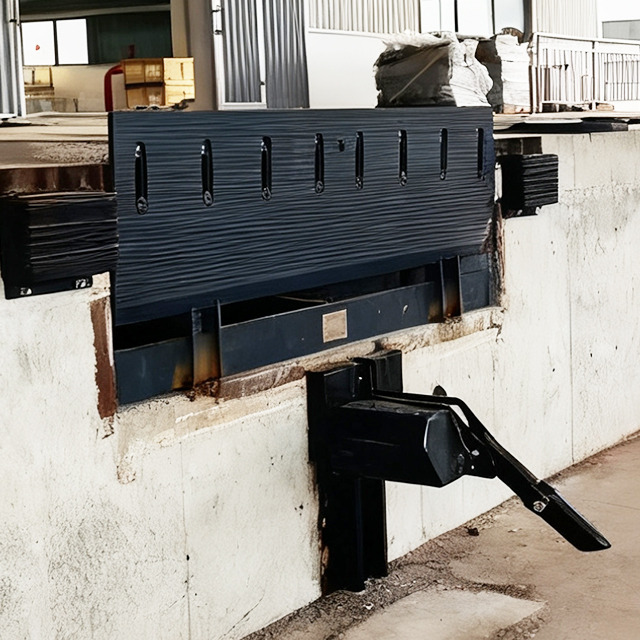

The working principle still focuses on bridging the height difference between the dock floor and the truck bed. However, the baffle structure may provide extra protection, guidance, or support depending on the design. It can help improve loading stability in certain warehouse conditions.
The main advantage is that they can be adapted to special loading environments. When a standard dock leveler cannot fully solve the loading problem, a baffle-type design may provide a more suitable solution.
Baffle dock levelers are often customized according to the site. This means the supplier needs to understand the dock height, truck type, working process, and safety concerns before recommending the final structure.
A baffle dock leveler may be suitable for loading docks with special traffic flow, unique truck positioning, limited installation space, or additional protection needs. It is not always the first option for standard warehouses, but it can be very useful in the right project.
Before choosing a baffle dock leveler, provide clear site photos, drawings, truck information, and loading process details. This helps the supplier judge whether a baffle-type structure is really necessary or whether a standard dock leveler can already meet the requirement.
An edge-of-dock leveler is installed at the edge of the loading dock instead of inside a pit. It is smaller and more compact than a standard pit-mounted dock leveler. It is usually used for light to medium-duty loading operations.
This type is often chosen when the warehouse does not have a dock leveler pit or when building a pit is not convenient. It can provide a simple bridge between the dock and the truck, but it has a smaller working range compared with full-size dock levelers.


The edge-of-dock leveler is mounted directly at the dock face. When a truck arrives, the operator activates the leveler and the lip moves onto the truck bed. After loading is completed, it returns to the stored position at the dock edge.
The biggest advantages are compact structure, easier installation, and lower cost. It does not require a large pit, so it is suitable for existing warehouses that need a basic loading solution without major construction work.
Edge-of-dock levelers have a smaller operating range and are not ideal for heavy-duty or high-frequency loading. If your warehouse handles large forklifts, heavy cargo, or trucks with big height differences, a hydraulic pit-mounted dock leveler may be better.
An edge-of-dock leveler is suitable for small warehouses, light loading operations, low-frequency use, and retrofit projects where pit construction is difficult.
Before choosing this type, confirm the truck bed height range and cargo weight. Edge-of-dock models are practical, but they must be used within the correct working conditions.
Loading frequency is one of the first things to consider. If your warehouse loads many trucks every day, you need a model that supports frequent use with easy operation. Hydraulic and telescopic dock levelers are usually better for high-frequency loading. Mechanical and edge-of-dock models are more suitable for lower-frequency applications.
For frequent loading, choose easier operation and stronger durability. For occasional loading, a simpler and more economical model may be enough.
Load capacity must match the real working conditions. You need to consider the weight of the forklift, operator, and goods together. Heavy-duty loading requires a stronger platform, reinforced structure, and reliable lifting system.
A dock leveler may experience repeated impact every day. Choosing a model with enough safety margin can help extend service life and reduce maintenance problems.
Some dock levelers require a pit, while others can be installed at the dock edge. Vertical dock levelers need enough internal space. Telescopic dock levelers need accurate matching with truck and dock conditions.
Before confirming the order, check dock height, pit size, opening width, power supply, wall structure, truck approach area, and installation clearance. Accurate site information helps avoid installation problems.
If your warehouse is temperature-controlled, sealing performance becomes very important. Cold storage, food warehouses, and pharmaceutical facilities need better sealing than general warehouses.
Vertical dock levelers and telescopic dock levelers are often better choices for facilities with higher sealing requirements. They can work together with inflatable dock shelters, insulated sectional doors, and cold storage high speed doors to reduce air leakage.
For most general warehouses, a hydraulic dock leveler is a safe and practical choice. It provides easy operation, stable performance, and good adaptability to daily loading work. If the loading frequency is low, a mechanical dock leveler can also be considered.
Hydraulic dock leveler for regular daily loading. Mechanical dock leveler for lower-frequency or budget-sensitive projects.
Logistics centers usually have frequent truck movement and tight schedules. The dock equipment must be fast, durable, and easy to operate.
Hydraulic dock levelers or telescopic dock levelers are recommended. If trucks arrive frequently and loading speed is important, hydraulic operation can reduce waiting time and improve workflow.
Cold storage and food facilities need better sealing, temperature control, and hygiene. The loading dock should reduce cold air loss, dust, moisture, and insects.
Vertical dock levelers and telescopic dock levelers are better options for higher sealing performance. They can be used with inflatable dock shelters and insulated doors to build a more complete cold chain loading system.
Some warehouses do not have a standard dock pit or do not want major construction work. In this case, compact equipment may be more suitable.
Edge-of-dock levelers are suitable for light-duty loading and retrofit projects. They are easier to install and more cost-effective, but they should not be used for heavy-duty loading beyond their working range.
Some projects have special dock layouts, unusual truck positioning, or additional protection needs. A standard model may not fully match the site.
Baffle dock levelers or customized dock levelers can be considered. The final design should be based on site photos, drawings, truck data, and real loading process details.
Price matters, but it should not be the only factor. A cheaper dock leveler may cost more later if it does not match your operation. Poor matching can lead to slow loading, frequent maintenance, safety problems, or shorter service life.
A good dock leveler should improve loading efficiency, reduce downtime, and support safe daily operation. Long-term reliability is often more important than the lowest initial price.
Many buyers only provide the dock opening size, but truck information is just as important. Truck bed height, truck width, rear door structure, and loading method all affect dock leveler selection.
Before choosing a model, confirm the types of trucks used at your warehouse. If the truck height range is large, a more flexible dock leveler may be needed.
If the load capacity is too low, the dock leveler may become unsafe or wear out quickly. The actual working load includes the forklift, the operator, and the cargo.
Do not choose the rated capacity too close to your maximum load. A proper safety margin is important for daily industrial use.
A dock leveler does not work alone. It often needs to work with dock shelters, dock seals, industrial doors, dock bumpers, vehicle restraints, and safety lights.
A complete dock system can improve loading efficiency, safety, sealing, and overall warehouse performance. Choosing products together can also make installation and operation smoother.
There is no single dock leveler type that fits every warehouse. Hydraulic dock levelers are practical for regular and frequent loading. Mechanical dock levelers are simple and economical for lower-frequency use. Airbag dock levelers offer an alternative lifting system with smooth operation. Vertical dock levelers are ideal for cold storage and clean facilities. Telescopic dock levelers provide better positioning and flexibility. Baffle dock levelers can support special project requirements. Edge-of-dock levelers are compact solutions for light-duty loading and retrofit projects.
The best choice always starts with your actual loading situation. You need to consider truck types, loading frequency, load capacity, site dimensions, sealing requirements, safety needs, and budget.
A well-chosen dock leveler can make your loading dock safer, faster, and more efficient. More importantly, it can support long-term warehouse performance and help your team handle daily loading work with less risk and less trouble.
Before ordering, it is better to provide your supplier with dock height, pit size, truck information, cargo weight, operation frequency, and site photos. With accurate information, the supplier can recommend the right dock leveler type and help you avoid unnecessary installation or operation problems.


